Showing posts with label "cotton on call". Show all posts

Monday, May 3, 2010

Weekly Commodity Market Recap: Cotton


for more analysis like this, please click here.

After reaching the highest levels in over two years the previous week, overbought cotton futures retreated last week, easing lower each of the first four days before rebounding modestly Friday as traders covered shorts and mills bought at these relatively lower prices. Nearby prices sank 207 points on the week to 84.13 cents per pound, easing in sympathy with a broad swath of commodities as the dollar re-strengthened. Brought on by Greek debt woes that threaten to spread across the European continent, the euro plunged last week, helping boost the dollar to 81.991 Friday, the highest weekly close in over a year. In turn, the higher dollar drove many commodity prices lower, including cotton. Lower unfixed call sales again last week foreshadowed the dip in futures prices. Even so, the CFTC Cotton On-Call position report shows a growing mass of mill buying under the market. Now at 2.6 million bales, the unfixed mill position should help support prices on any speculative related sell-off. The spec long position, which is much larger than the mill short position, has the advantage being able to roll forward. Mills must buy because they need the cotton, and most merchants would be unwilling to roll their contracts forward. It could be an interesting summer even if the weather cooperates.

By late in the week the dip in prices brought new business back to the market, boosted by continued signs of economic growth. The Commerce Department reported first quarter GDP rose an annualized 3.2%, the third consecutive quarter of expansion. What’s more, consumer spending led the growth, hinting at improving demand for cotton textiles and apparel in the world’s largest retail market. While evidence here confirms the recession had a devastating effect on per capita end use of cotton products in the U.S., a rising economic tide is likely to lift all ships, boosting fiber demand in 2010. A lackluster housing market and above-trend unemployment are likely to remain drags on net apparent consumption of cotton, but continued economic growth is likely to offset these negative forces, expanding cotton demand this year.

Away from the demand side, in the shorter term weather will become the dominant factor driving cotton prices, as reports of crop development and condition around the world weigh on the market. After a month of below-normal precipitation, Mato Grosso cotton in Brazil is in need of a good drenching before picking commences in earnest in coming weeks, else yields and production could suffer. Meanwhile, the Australian cotton harvest continues under clear skies and normal temperatures, boosting yield and quality prospects. With abundant year-to-date moisture levels here, tentative sentiment for higher yields in West Texas is widespread, while concern is mounting across the Southern Delta over too little rainfall. Given the persistent inversion in price between nearby contracts and more distant contracts, the market has long been hinting at a larger autumn harvest and increasing supplies for months. The question is whether—and how soon—this convergence in price between contract months happens as prices for more distant months firm, or if Nearby prices ease lower on signals of stumbling demand. Presently, we are not confident that either event will happen soon, suggesting this backwardation in the market may persist.

Monday, April 5, 2010

Weekly Commodity Market Recap: Cotton


for more analysis like this, please click here.

Futures prices rebounded during last week’s holiday-shortened trading, as a decline in the dollar and robust export sales were friendly to cotton prices, with futures remaining well within a six-cent trading range established over the last six weeks. Nearby cotton prices rose 181 points on the week to close at 81.50 cents per pound, with three days of higher prices offsetting Tuesday’s modest decline. Traders last week viewed the USDA’s Prospective Plantings report as a non-event. The 10.5 million-acre forecast for spring plantings was close to market consensus and our own projection discussed last week here. With this outlook already factored into the market, traders instead discerned price direction from other factors.

A more pronounced impact on the market came from a weaker dollar, which boosted prices for several commodities, including cotton. The U.S. Dollar Index lost over half a point last week, closing at 81.44. This spurred oil prices to almost $85/barrel late last week, nearing the highest point in seventeen months. Oil also is likely to benefit from Friday’s sanguine jobs data, igniting hopes of a pickup in energy demand. Longer term, higher oil prices could support higher synthetic fiber prices, helping shift demand back to cotton.

The weaker dollar also boosted prices for a host of commodities, helping drive the rebound in cotton prices. The Reuters/CRB Index jumped last week to more than 276.4, nearing its highest level in two and a half months. Part of the positive commodity price action was attributable to more positive manufacturing news. The latest report from the Institute for Supply Management showed manufacturing activity made its largest jump since 2004. The increase was driven by significant growth in new orders and production. Almost all manufacturing sectors screened in the report showed a jump in activity, echoing the vigor we are witnessing in the domestic textile sector. While the rise in this basket-price of commodities did little to boost prices last week for crops that compete with cotton for southern acres—particularly corn, wheat, and soybeans—the increase cemented sentiment that cotton will reclaim a large swath of acres lost to other crops over the last two years.

Closer to home, two key indicators helped propel cotton prices higher on the week. First, weekly export sales were surprisingly good with a total of 279,000 bales in new sales recorded. Shipments were also excellent at 301,500 bales. Also, rumors are spreading that China—the world’s largest cotton importer—is likely to increase its import quota again in coming weeks, boosting prospects for additional shipments before the end of the marketing year. This evidence prompted us to revise our U.S. export forecast higher than the USDA here, friendly to higher prices. A second key indicator is the recent surge in unfixed call sales. At 70,424 contracts, the volume in unfixed call sales is the highest in over two years, helping weekly cotton futures rebound to one of the highest closes in over two years.

As the marketing year winds down, trading in coming days is less likely to be influenced by the next USDA WASDE report due Friday and more likely to be driven by weather developments. We look for April’s WASDE to show modestly tighter fundamentals in the U.S., mostly due to higher U.S. exports this marketing year. But small adjustments to old-crop fundamentals also are likely to become more of a non-issue in coming weeks, as the market’s attention turns to the size of spring plantings in the northern hemisphere and weather conditions after germination.

Monday, March 22, 2010

Weekly Commodity Market Recap: Cotton


for more analysis like this, please click here.

Cotton prices managed to rebound last week, in spite of mounting bearish evidence hinting at the increased potential for a pullback. Viewed from the bulls’ perspective, cotton’s climb last week came on news of higher unfixed on-call sales and the biggest U.S. cotton exports in nine months. The CFTC’s latest Cotton on Call report indicates unfixed on-call sales are growing at a rapid pace, particularly in the July contract. Total unfixed on-call sales merchants made to textile mills jumped to 68,829 contracts, the highest in two years, supporting higher ICE futures. The July contract rose by 816 contracts to a record 23,159. There are only 11,713 unfixed on-call purchases merchants have made from growers, providing very little in the way of an “offset”. As mills continue to add to their on-call position, it represents more futures that will need to be bought during a smaller window of time, suggesting higher prices are likely.


The bulls also point to the latest report of robust sales and shipments abroad for cotton. Total exports of Upland and Pima cotton reached 312,661 480-lb. bales in the week ending March 11, driven by soaring volume to America’s largest market. Exports destined for Chinese textile mills surged to 152,268 bales, the highest level so far this marketing year. In fact, this weekly volume was almost as much as the U.S. shipped to all other markets combined, reflecting China’s expanding share of total U.S. cotton exports over the last several months. The surging shipments to China in recent weeks echo our observation here of rapid growth in total Chinese cotton imports and suggest cumulative U.S. exports to China this marketing year may climb to the second-highest level ever recorded, something certainly bullish for price.

But from a stronger dollar to higher acreage forecasts for spring plantings, different bearish indicators are looming and likely to offset much of the enthusiasm for higher prices in coming weeks. Greece’s ongoing debt problems led to a weaker euro and stronger dollar last week, limiting gains on commodities. The U.S. Dollar Index finished the week higher at 80.7, rivaling its highest level in 21 months and hindering gains across a variety of commodities.

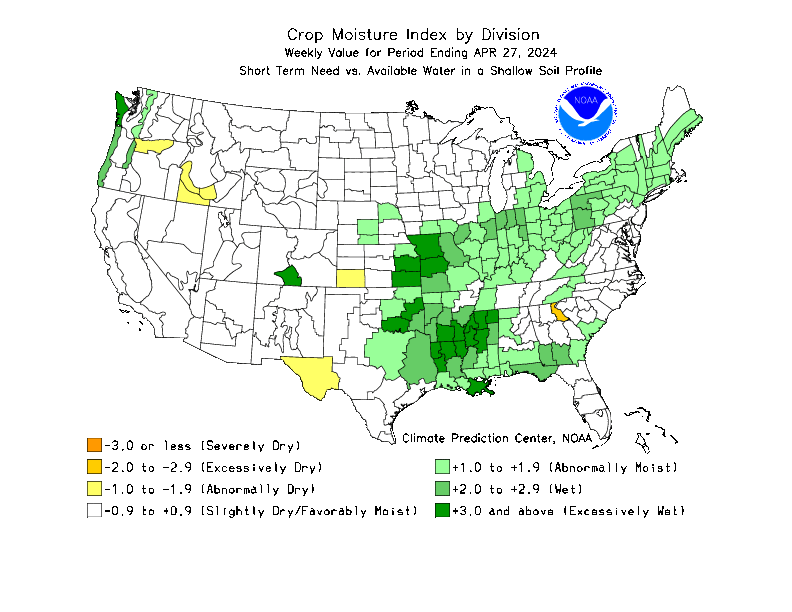
Finally, some price impacts may be coming from excellent topsoil moisture reports across the South and private acreage estimates released last week. One planted acreage report disseminated last week pegged spring U.S. cotton plantings at 10.3 million acres, well up from a year earlier. The market is likely to trend sideways in coming days, in anticipation of the March 31 Prospective Plantings report from the USDA. While the market looks for an increase in cotton acres this spring, the question is how much. Certainly, weather in coming months will impact yields—something difficult to accurately gauge this early in the year—but one early hint at the potential for better-than-average yields is ample topsoil moisture. The latest nationwide map here shows much of the South is wetter than normal, with no cotton acres reported as abnormally dry. This early sign hints that the surge in price over the last year may slow in coming weeks under the weight of a much larger cotton crop.

Tuesday, January 19, 2010

Weekly Commodity Market Recap: Cotton


for more analysis like this, please click here.

The corrective consolidation in prices extended into the latest week, as weaker cotton fundamentals, plunging Chinese prices, and lower commitments of traders data weighed on U.S. prices. The nearby March contract finished the week down a modest 36 points from the week before, at the lowest close since mid-November.

The week began with an impressive 180-point jump Monday, buoyed by a weaker dollar and sentiment for tighter global ending stocks in Tuesday’s WASDE report from the USDA. However, the optimism for higher prices sagged Tuesday, with prices falling three of the next four days following release of the WASDE report. Tuesday prices gave back most of Monday’s gains, falling 145 points. While USDA projections for U.S. fundamentals closely matched FCStone forecasts, the USDA figures for global supply and demand were more bearish than the market had anticipated. The bearishness carried over into the following day, when Wednesday prices tested the previous week’s low of 72.43, before closing at 73.43, up 64 points. The only other note of bullishness came Thursday following the release of the U.S. export sales report. At 460,726 480-lb. bales of Upland and Pima, sales climbed to a marketing-year high. Similarly, exports jumped in the latest week to 211,891 bales, the biggest volume since early October. Cotton destined for China accounted for the bulk of the surge, with weekly shipments the most in eight months. But in spite of this news, prices eased lower each of the last two days of the week, finishing at 72.08—a seven-week low—sunk by weaker Chinese prices and a stronger dollar.

Even as prices have eased from recent highs on the ICE Futures U.S. exchange, prices on China’s Zhengzhou Commodity Exchange have fallen much faster, weighing on global markets. Since peaking on January 4, the most-traded May contract is off 1,010 yuan per metric ton (6.72 cents per pound) to 15,830 yuan per ton, outpacing the 3.92-cent drop in March futures on the ICE exchange. Market open interest is well off its record peak set two weeks ago as well, falling by more than a third. The plunge both in open interest and prices on the ZCE is pulling market prices on this exchange closer into parity with U.S. futures prices, something we anticipated here.

U.S. futures also are easing lower on signals from the trade. First, reports of lower unfixed call sales from the CFTC weighed on futures prices last week. A significant net reduction took place on the mill side in unfixed on-call positions during last week's price skid, where mills fixed prices on 3,324 lots to reduce unfixed call sales to 49,548 lots. Unfixed holdings on the producer side increased a net 46 lots to 10,524. A second report from the CFTC showed funds and speculators cut cotton futures-options net longs to lowest combined total since week ended Nov. 24, trending in step with the decline in futures prices. Commercials reduced net shorts to 53.2% of open interest, down 10.7 percentage points from eight weeks earlier. Meanwhile, funds and speculators reduced their net longs by a combined 8,587 lots in cotton futures with options during the week ended last Tuesday, according to supplemental data reported by the CFTC Friday. They were net long a combined 131,333 lots, the lowest since the week ended November 24. Trend-following funds trimmed their net longs by 6,255 lots to 41,049, index funds pared theirs by 2,281 lots to 78,055 contracts, and small specs cut theirs by 80 lots to 12,299. The reduction by index funds came on the heels of earlier expectations for a fresh influx of money into the cotton market around the first of the year as a result of rebalancing and has sapped much of the market’s enthusiasm for higher prices.

As a result of the weaker global fundamentals, steep drop in Chinese prices, and unexpected declines in traders’ commitments, futures prices are well off their early-January highs. However, merchants still need to purchase more futures contracts than sell in order to even out their on-call positions, suggesting sentiment has not tilted to the bears just yet. We continue to expect prices to move sideways to higher over the next few weeks, once this correction is fully digested. But should alternative row crops remain at current levels, this divergence in prices will likely prompt a modest increase in U.S. cotton plantings in the spring, which longer term may stem the gains in cotton prices.

Wednesday, December 9, 2009

Are ICE and ZCE Cotton Futures Poised to Strengthen Further in Second Half of 2009/10?

for more analysis like this, please click here.

After the unprecedented spike in global cotton prices witnessed in 2008 and the resultant shockwaves felt thereafter across the global cotton market, prices in 2009 returned to levels more in line with traditional influences. These drivers include factors internal and external to the cotton market, and show strong correlations to futures prices. Looking ahead to 2010, these signals suggest cotton prices are likely to remain firm, above their long-term average level, as the global economy re-accelerates from a tumultuous 2008, driving renewed growth aggregate demand for cotton textiles and apparel.

Perhaps one of the most influential drivers on global and U.S. cotton prices is fundamental analysis. The study of the ebb, flow and interaction of supply and demand yields insight into current price levels and can hint at the future direction of price. A measure of this interaction, the stocks-to-use ratio, is often strongly correlated with price. More specifically, the tighter or looser the ratio between anticipated ending stocks and expected demand changes, the higher or lower we can expect price to trend. This relationship is evident in the graph below, showing that in recent months, the forecasted stocks-to-use ratio for the U.S. cotton market has fallen, or tightened. As this has occurred, the monthly average futures price has risen in tandem, breaching 70 cents per pound over the first few days in December.

Analysis of the stocks-to-use ratio can yield important clues to the future direction of price. For example, the USDA’s November forecasted stocks-to-use ratio for the 2009/10 marketing year is 35.2%, the smallest ratio in fourteen months. Not coincidentally, November’s average prices for nearby cotton on ICE Futures U.S. were 68.73 cents per pound, the highest in fifteen months. Reports of likely changes in supply and demand can cause this anticipated ratio to rise or fall, in turn driving price lower or higher in tandem.

Looking ahead to 2010, we expect the U.S. stocks-to-use ratio to tighten further in coming months, suggesting price could strengthen even further. We base our forecast on prospects that the U.S. harvest size may be smaller than currently projected, and on the belief that U.S. exports may outpace the current target in the remaining months of this marketing year. Certainly, this bullish outlook is tempered by the notion that prices already outpace the level suggested by this historic relationship. This implies that any continued appreciation in futures prices may not be commensurate with continued declines in the stocks-to-use ratio. Regardless, we look for the market to remain firm well through winter, perhaps until attention turns to the outlook for higher cotton plantings again in the spring.

Looking more broadly across the U.S. economy, factors external to the cotton market are also having a strong influence over cotton prices. First, the weaker U.S. dollar is boosting the outlook for a host of exportable commodities, including cotton. Both the dollar and cotton prices moved in lock-step over the last two years and presently stand near levels not seen in sixteen months. The outlook for the dollar in 2010 is dependent upon myriad factors both in the U.S. and abroad, including the outlook for interest rates, capital markets, inflation, government policies, and other economic indicators. While it remains impossible to accurately forecast the value of the dollar, we, along with many other market observers, remain pessimistic on the prospects for the greenback, helping support the outlook for a range of commodity prices, including cotton.


Second, speaking of capital markets, cotton prices have had an uncanny correlation with equity prices in the U.S. recently. As darkening clouds over the U.S. economy grew more ominous in the final months of 2007, stock markets in the U.S. began a hasty retreat as investors moved money to safer investments. After peaking in October 2007, the Dow Jones Industrial Average lost more than half its value over the next year and a half, falling to its lowest level in a dozen years. Since then, the Dow has posted one of its biggest rebounds in history, soaring roughly 50% from its March 2009 low. The Dow now sits near its highest level in fourteen months. Similarly, after spiking to the highest level in years in early 2008, cotton futures prices plunged more than 60% over the next eight months to 39.14 cents per pound, the lowest level in more than six years. Since then, nearby cotton prices have steadily climbed, surpassing 70 cents for the first time in sixteen months. Similar to gauging the value of the dollar, forecasting stock prices naturally is next to impossible. But many analysts agree that the impressive jump in the Dow in 2009 is unlikely to be duplicated in 2010, suggesting that any continued re-strengthening in cotton prices is likely to come at a slower rate than witnessed this year.
Aside from fluctuations in cotton supply and demand and factors external to the cotton market, the sales of merchants and positions of large traders and funds in the market continue to be strongly correlated to cotton prices. Week-to-week on-call sales across all contract months continue their co-movement with nearby cotton futures over the last two years. In fact, less than two months ago unfixed call sales reached 54,135 contracts—their highest level in fourteen months—at the same time that weekly nearby prices surpassed 68 cents, the highest level in sixteen months. In the weeks since, a gap opened between the two measures. But we look for this divergence to narrow in coming months, whether in the form of lower cotton prices or higher unfixed call sales. Given the bullish other factors noted earlier, we are more confident that unfixed call sales will slowly expand to fill that gap.


The role of hedge and index funds is likely to remain integral to commodity prices—including cotton—well into 2010. The increasing prevalence of long-only commodity indexes and the increasing acceptance of commodities as an asset class are helping drive interest—and therefore volume—in this area, boosting prices. Likewise, the prominence of agricultural commodities in these indexes has substantially increased in recent years. The cotton market has enjoyed a relatively consistent share of the surge of index and hedge fund monies into the market over the last two years, supporting price. In fact, for well over two years, the ebb and flow of index funds’ net positions have mirrored the rise and fall of cotton prices. Just as the net position of index funds is hovering near a fourteen-month high, so too are cotton prices. Looking ahead, aside from political wrangling over new bills governing increased transparency for some larger market participants, we see little reason to expect the inflow of hedge and index funds to ease in 2010, supporting an outlook for robust price in the months ahead.

Lastly, we turn away from the U.S. futures market to the impressive performance of cotton on the Zhengzhou Commodity Exchange. Since commencing trading on the ZCE over five years ago, cotton futures prices have trended in step with their American counterparts, reflecting efficient market-clearing and price-discovery mechanisms in place in both markets. Clearly, the issues that impact price in one market are felt half a world away, driving price in the other market.

This relationship has been particularly evident over the last year, when prices on both the ICE Futures U.S. and the ZCE exchanges reached near-term lows on virtually the same day. Since then, nearby prices on both exchanges have risen in step with one another to the highest levels in roughly fourteen months. It is only over the last month that ZCE cotton prices continued to climb, far outpacing gains on the ICE and peaking recently at record levels just as market volume also soared to more than 500,000 contracts, also a record. This surge in price easily outpaces gains in downstream intermediate yarns and fabrics and appears inherently inflationary—and therefore unsustainable. While we are optimistic on the prospects for continued strength in global cotton prices into 2010, we are not as confident ZCE prices will be able to maintain such a premium. We expect that any continued gains in ICE futures prices are unlikely to be met with commensurate increases in ZCE prices. And should this sudden spike in ZCE volume and open interest suddenly plunge, we would expect Nearby prices in China to retreat closer in line with U.S. futures prices in coming months.

Monday, December 7, 2009

Weekly Commodity Market Recap: Cotton

Bullish internal influences grappled with bearish external drivers last week, keeping cotton mired within the previous week’s trading range. In the global cotton market, supply and demand indicators both hinted at tighter fundamentals in coming months. In the U.S., an early-season snow here blanketed much of the remaining unpicked northern cotton crop from New Mexico across the Mid-South. While this snow did not last long, this year’s crop is the latest on record and any remaining fiber still in the field is likely to see big increases in boll rot and declines in yield and quality in wintry weather increases. Across these states, only about 10% of the crop remains in the field, accounting for roughly 300,000 bales.

Globally, voices in Pakistan and India are adding to the growing chorus calling for all-out bans on cotton exports from both countries. Local industries in both markets are concerned over intensifying shortages of fiber and yarn here, prompting calls to both governments to take action. While we do not expect either administration to implement these requested bans, both governments will be obliged to listen to the concerns of the industries and may offer some token policy to encumber exports and placate the industries, either in the form of additional registrations or new export levies. While not as severe as an all-out ban, this action would remain bullish for global prices.

On the demand side, U.S. export sales were phenomenal for a holiday-shortened week, even if shipments lagged the pace we would have like to have seen. Net upland sales reached 250,700 running bales, the most in more than three months. China remained the dominant buyer, followed by strong sales to Turkey and surprisingly to Brazil. We are anxious to see if this jump will continue next week, or if mills are guilty of panic buying once again.

Speaking of textile mills, the weekly Cotton On-Call report here raised a few eyebrows. After falling for five straight weeks, unfixed on-call sales made by merchants to textile mills increased by 3,612 contracts last week and now stand at 49,582. Meanwhile, unfixed on-call purchases mills have made from growers grew only 92 contracts to 9,064. The March contract shows a greater imbalance, with unfixed on-call sales increasing 5,413 to 21,111 while on-call purchases fell 360 to 3,258 contracts. If mills are not proactive about fixing their March cotton, it is not entirely out of the question that we may see another bullish repeat of the December situation where mills need to fix, and there are few sellers left right before first notice day arrives.

Outside the cotton markets last week a stronger dollar, a retreat in crude oil prices, steep losses in gold futures and weak prices for grains all weighed on cotton futures. In spite of the bullish influences noted earlier, nearby cotton futures sank two points from the week before to 73.82 cents as these external factors weighed on price. Late in the week, a rally in the dollar, spurred by thoughts that interest rates may rise sooner rather than later after the economy lost a much fewer-than-expected 11,000 jobs last month, exerted broad influence on commodities. NYMEX oil sank to $75.47 last week, its lowest weekly close in two months. After soaring thirteen of the last fifteen weeks to a record high last week, gold also lost some of its luster following a Friday sell-off, sinking well below $1,200/ounce. Alternative crops also wilted under the dollar pressure. After reaching a six-month high last Monday, nearby wheat futures fell each of the next four days, trending lower in step each day with lower corn prices. As these opposing forces jostle for the dominant influence over cotton prices, we still look for the market to move higher, just not quite yet.

Monday, October 19, 2009

Weekly Commodity Market Recap: Cotton

Buoyed by supply concerns and bullish outside influences, cotton prices extended their impressive streak of gains last week, rising to the highest levels in more than fourteen months. December futures rose for the eighth time in ten sessions Friday, up more than 750 points over the last two weeks. At 68.21 cents per pound, the December contract finished the week up for the fifth time in the last seven weeks as the bulls clearly dominated the news.

Concerns continue to mount over harvest prospects in several markets. In particular, Delta cotton fields in the U.S. remain soggy from persistent rains over the last month, hindering and delaying harvesting. Evidence here shows near-record rains fell over recent weeks in the area, and are likely to damage yield and quality to cotton from the region. Also, after suffering through its third summer of drought, recent downpours in California discussed here have come at a most unwelcome time, with virtually all the cotton bolls open, but hardly 6% of the crop harvested. Adding to the dismal outlook, Hurricane Rick in the eastern Pacific here may complicate harvests in Texas closer to the weekend, further compromising the U.S. crop.

Too much rainfall also remains a concern in China, where futures prices are flirting with their highest levels in almost a year and a half. Several eastern provinces report delays in harvesting and damage to quality from untimely rains, driving local prices higher. In fact, even with prices continuing to firm, evidence here shows many producers remain reluctant to sell, expecting prices to rise further. Recently-revised forecasts promulgated within the country here point to lower production and higher demand, supporting this sentiment, boosting domestic prices.

Even away from the fundamentals, other signs point to continued strengthening in price. The dollar continues to sink lower, plunging to its lowest weekly close in fourteen months, helping boost a wide range of commodity prices. Cheerful words from the Fed and the Treasury are doing little to turn investor sentiment back to the dollar, particularly after last week’s news of a record $1.4 trillion deficit in the U.S. Also, money flow into cotton has been impressive and open interest is exploding. New speculative money matched up against new commercial hedging has amplified the expansion of open interest. And unfixed call sales reported here in last week’s Cotton on Call report rose to a thirteen-month high, supporting continued gains in price.

This string of higher closes is reminiscent of the period two years ago when futures began their march to the highest levels in years, culminating in the March 2008 spike. While this is not the same market—with the same outside influences and hysteria driving prices higher—the trend remains firmly with the bulls, even as the bears point to the need for a correction. For now the market has some strong upward momentum.

Monday, October 12, 2009

Weekly Commodity Market Recap: Cotton

After retreating the two previous weeks, cotton prices firmed last week, supported by external and internal factors that were friendly to the market. Nearby cotton prices in the U.S. rose 236 points on the week to finish at 63.02 cents per pound, the highest close in three weeks. Outside influences boosting cotton futures included rebounding stock and commodity prices and a weaker dollar, while the internal factors of tighter supply/demand estimates from the USDA and higher unfixed call sales helped reverse last week’s slide.

Exogenous factors continue to have a large influence over the cotton market. Cotton prices responded to an improving stock market, as the Dow Jones Industrial Average gained 372 points on the week to flirt with its highest level in a year. Higher prices for key commodities also helped boost cotton futures. Corn, soybean, and wheat all saw solid gains on the week, as prices in the broader commodity complex rose in response to a weaker dollar. The CRB Index of nineteen raw materials saw its biggest weekly jump since the spring, finishing at its highest weekly close in two months. Speaking of the dollar, the greenback sagged further last week on speculation the Federal Reserve will trail other central banks in raising interest rates, making the currency less attractive. A rising cacophony of voices around the world questioning the reserve status of the dollar doesn’t help bolster sentiment for the currency, either.

Improving fundamentals more directly tied to the cotton markets also pointed to firmer prices last week. As we expected here, a report from the USDA anticipating smaller ending stocks domestically and worldwide this marketing year helped buoy prices. Here the USDA lowered the projected harvest size in the U.S. by 440,000 bales from last month, with most of the decline coming from Texas. This leaves us believing production may decline further in coming months, as many analysts are looking for lower yields and quality from Mid-South states. Worldwide, production forecasts here sank 1.3 million bales from last month, with the Chinese harvest withering by one million bales. Additionally, the latest volume of “on call’ positions reported by merchants here jumped to the highest level in more than a year, carrying cotton prices higher. At 50,423 contracts, unfixed call sales outnumber unfixed call purchases by more than three-to-one, the widest gap in more than a year.

Looking ahead, we are mildly bullish in the short term. We continue to feel the damage to the Mid-South crop is not fully reflected in the U.S. production outlook. Further, there is more adverse weather in the forecast, which doesn’t make physical traders necessarily bullish, rather more hesitant to be very bearish. Speculators are just plain bullish and appear ready to exact continued pressure on the unfixed spinners. We look for December to have room to strengthen further in coming weeks, likely beyond near-term resistance levels.